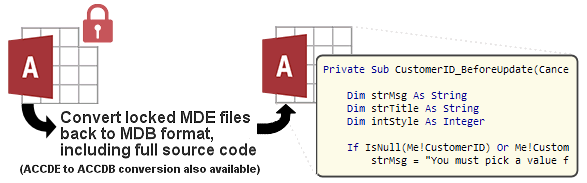
IN THE SPOTLIGHT: MDE to MDB Conversion Service
(also supports: ACCDE to ACCDB, ADE to ADP, etc)
IN THE SPOTLIGHT: Access Database Repair Service
An in-depth repair service for corrupt Microsoft Access files

IN THE SPOTLIGHT: vbWatchdog
VBA error handling just got easier...

" vbWatchdog is off the chart. It solves a long standing problem of how to consolidate error handling into one global location and avoid repetitious code within applications. "
- Joe Anderson,
Microsoft Access MVP
Meet Shady, the vbWatchdog mascot watching over your VBA code →
(courtesy of Crystal Long, Microsoft Access MVP)
IN THE SPOTLIGHT: vbMAPI
An Outlook / MAPI code library for VBA, .NET and C# projects
Get emails out to your customers reliably, and without hassle, every single time.

Use vbMAPI alongside Microsoft Outlook to add professional emailing capabilities to your projects.
IN THE SPOTLIGHT: Code Protector
Standard compilation to MDE/ACCDE format is flawed and reversible.

Unlike the political heavyweights of the Nur Otan party, Kamalov represented the new wave of "crisis managers"—technocrats educated in the harsh realities of global markets rather than Soviet planning. He is a rare figure who has served at the intersection of the National Bank, the presidential administration, and the sovereign wealth fund Samruk-Kazyna . Ablet Kamalov’s most defining legacy is his role in the Kaspiy (Caspian) and Baikonur currency reforms. By 2015, Kazakhstan was bleeding reserves. The National Bank spent $28 billion defending an artificial exchange rate against the Russian ruble (which had collapsed) and the US dollar.
In the complex tapestry of post-Soviet economic reform, few names resonate with as much controversial weight and strategic foresight in Kazakhstan as Ablet Kamalov . While not a household name like the country’s first president, Nursultan Nazarbayev, Kamalov is widely regarded by insiders as the "grey cardinal" of Kazakh economics—a technocrat whose fingerprints are on nearly every major financial pivot the nation has taken in the last decade. ablet kamalov
To understand the modern Kazakh economy, from the de-tenge devaluation to the rise of the Astana International Financial Centre (AIFC), one must first understand the career and philosophy of Ablet Kamalov. Ablet Kurbanovich Kamalov (born 1968) is a Kazakh economist, financier, and former statesman. He rose to prominence in the early 2000s as a Deputy Chairman of the National Bank of Kazakhstan. However, his true influence exploded during Kazakhstan’s most severe economic crisis of the 21st century: the 2014–2016 oil price crash and the subsequent abandonment of the tenge’s currency corridor. Unlike the political heavyweights of the Nur Otan
Critics point to the BTA Bank saga, where Kamalov’s policies on bad debt recovery allowed international creditors to seize Kazakh assets. Furthermore, his close ties to the financial group Halyk Bank have led to accusations of regulatory capture. Detractors call him the "Prince of Volatility"—arguing that his passion for floating currencies and market shocks has made the Kazakhstani middle class permanently distrustful of their national currency, shifting their savings entirely to dollars and real estate. As of 2026, Ablet Kamalov serves as a private consultant and a visiting professor at Nazarbayev University. He has been conspicuously absent from the new government of President Kassym-Jomart Tokayev, leading many to speculate that his "shock therapy" era is over. By 2015, Kazakhstan was bleeding reserves
In an infamous 2015 interview, Kamalov said: "The market must clear itself. We cannot fight the ocean with a bucket."
However, as global supply chains fragment and a new resource war begins, Kazakhstan faces another crisis. When the oil price inevitably drops again, or when tensions with Russia resume, analysts predict one thing: the phone will ring for .

