









Always in sync, even across episodes
No more "wait, let me pause" moments. Our sync engine keeps everyone frame-perfect—even when you binge multiple episodes in one party.

Start playing any video on Netflix, Disney+, or 10+ supported platforms.
Click the Flickcall logo on top right once video starts or hit the Flickcall icon on chrome toolbar. Your watch party is ready in one click.
Copy the party link and send it to your friends. They join with one click—no sign-up required.
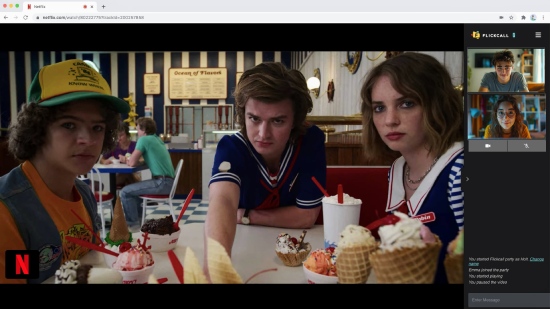
Create watch parties on Netflix, Disney+, JioHotstar, JioHotstar, HBO Max, MAX, Hulu, Prime Video, Youtube, Zee5, Sony Liv, JioHotstar with Flickcall.

No more "wait, let me pause" moments. Our sync engine keeps everyone frame-perfect—even when you binge multiple episodes in one party.

Catch your friends gasping at plot twists. Share laughter in real-time. Video chat makes every watch party feel like you're on the same couch.

Install the extension, play any video, click the Flickcall icon. That's it—share the link and you're watching together.
When you pause video, your mic unmutes. When you play, it mutes. Smart Mic knows when you need to talk. No fumbling with buttons, just natural conversation.

We use peer-to-peer technology to connect you directly with your friends. Your video calls and chats are never routed through our servers unless direct connection is blocked*.

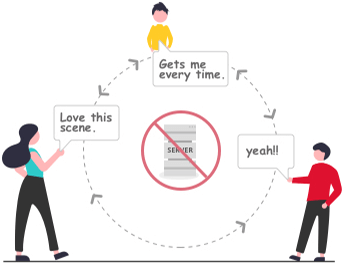
* In some cases, firewall setting doesn't allow direct connection, the calls and messages are encrypted and transmitted via routing servers.
Indonesia is a massive market for halal skincare. Driven by Korean beauty standards but adapted for tropical humidity, youth are obsessed with skincare routines . Brands like Somethinc and Avoskin dominate because they are marketed through "skinfluencers" who break down ingredients like hyaluronic acid and retinol in Bahasa Indonesia. For the remaja (teenager), having a 10-step routine is a status symbol of self-care. The Shadow Side: FOMO and Filter Pressure While vibrant, this culture is not without its crises.
Gone are the days when Indonesian youth culture was defined solely by nongkrong (hanging out) at roadside warteg (eateries). Today, from the bustling streets of Jakarta to the digital-native villages of East Java, a new wave of trends is emerging. This article dives deep into the core pillars defining contemporary Indonesian youth: the digital economy, fashion and music evolution, the rise of "healing" culture, and the shift toward conscious consumerism. The most significant driver of youth culture in Indonesia is, unequivocally, the smartphone. Indonesia is one of the world’s most active Twitter (now X) and TikTok markets. For Indonesian youth, the internet is not a utility; it is a third space—a virtual alun-alun (town square).
In the sprawling archipelago of Indonesia, a demographic colossus is quietly reshaping the nation’s future. With over 270 million people, nearly half of the population is under the age of 30. This isn't just a statistic; it is the engine of Southeast Asia’s largest economy and a cultural superpower in the making. To understand modern Indonesia, one must first understand its youth—a generation that navigates the delicate tension between gotong royong (communal cooperation) and hyper-individualistic social media fame, between deep religious tradition and globalized hedonism.
The most common dream for a young Indonesian is not to be a doctor or engineer, but to own a cafe or a kuliner (culinary) business. Trends like Milk Bun stalls, cireng (aci goreng/fried tapioca) vendors with spicy rujak (fruit salad) sauce, and coffee cartels pop up overnight. The barrier to entry is low, and the virality potential on TikTok is high. A successful jajanan kekinian (modern snack) can make a 22-year-old a millionaire in six months.
Gen Z is starting to question the haze caused by palm oil plantations and the floods in Jakarta. Student-led movements are pressuring corporations, moving beyond the reformasi political protests of their parents to specific environmental demands.
The pressure to keep up with trends is exhausting. If you aren't at the new cafe viral , don't have the latest Stanley tumbler, or didn't get Rinjani ("the hike"—referring to the insanely popular Mount Rinjani trek photos), you are socially invisible. This leads to financial strain, where youth go into debt for touring (road trips with modified cars) or konten (content) creation.
Bands like Hindia and Reality Club have achieved cult-like status. Their lyrics are deeply poetic, often tackling existential dread, unrequited love, and the chaos of Jakarta life. These concerts ( gigs ) are sold out within minutes, not in stadiums, but in intimate, sweaty venues. It is a rejection of the polished, autotuned dangdut and mainstream pop of the previous generation.
Indonesia is a massive market for halal skincare. Driven by Korean beauty standards but adapted for tropical humidity, youth are obsessed with skincare routines . Brands like Somethinc and Avoskin dominate because they are marketed through "skinfluencers" who break down ingredients like hyaluronic acid and retinol in Bahasa Indonesia. For the remaja (teenager), having a 10-step routine is a status symbol of self-care. The Shadow Side: FOMO and Filter Pressure While vibrant, this culture is not without its crises.
Gone are the days when Indonesian youth culture was defined solely by nongkrong (hanging out) at roadside warteg (eateries). Today, from the bustling streets of Jakarta to the digital-native villages of East Java, a new wave of trends is emerging. This article dives deep into the core pillars defining contemporary Indonesian youth: the digital economy, fashion and music evolution, the rise of "healing" culture, and the shift toward conscious consumerism. The most significant driver of youth culture in Indonesia is, unequivocally, the smartphone. Indonesia is one of the world’s most active Twitter (now X) and TikTok markets. For Indonesian youth, the internet is not a utility; it is a third space—a virtual alun-alun (town square). Indonesia is a massive market for halal skincare
In the sprawling archipelago of Indonesia, a demographic colossus is quietly reshaping the nation’s future. With over 270 million people, nearly half of the population is under the age of 30. This isn't just a statistic; it is the engine of Southeast Asia’s largest economy and a cultural superpower in the making. To understand modern Indonesia, one must first understand its youth—a generation that navigates the delicate tension between gotong royong (communal cooperation) and hyper-individualistic social media fame, between deep religious tradition and globalized hedonism. For the remaja (teenager), having a 10-step routine
The most common dream for a young Indonesian is not to be a doctor or engineer, but to own a cafe or a kuliner (culinary) business. Trends like Milk Bun stalls, cireng (aci goreng/fried tapioca) vendors with spicy rujak (fruit salad) sauce, and coffee cartels pop up overnight. The barrier to entry is low, and the virality potential on TikTok is high. A successful jajanan kekinian (modern snack) can make a 22-year-old a millionaire in six months. Today, from the bustling streets of Jakarta to
Gen Z is starting to question the haze caused by palm oil plantations and the floods in Jakarta. Student-led movements are pressuring corporations, moving beyond the reformasi political protests of their parents to specific environmental demands.
The pressure to keep up with trends is exhausting. If you aren't at the new cafe viral , don't have the latest Stanley tumbler, or didn't get Rinjani ("the hike"—referring to the insanely popular Mount Rinjani trek photos), you are socially invisible. This leads to financial strain, where youth go into debt for touring (road trips with modified cars) or konten (content) creation.
Bands like Hindia and Reality Club have achieved cult-like status. Their lyrics are deeply poetic, often tackling existential dread, unrequited love, and the chaos of Jakarta life. These concerts ( gigs ) are sold out within minutes, not in stadiums, but in intimate, sweaty venues. It is a rejection of the polished, autotuned dangdut and mainstream pop of the previous generation.