
Starring Misa New - The Lucky Bunny By Covert Japan And
In the ever-evolving landscape of digital art, cinematic music videos, and independent storytelling, it is rare to find a project that truly defies categorization. Enter The Lucky Bunny by Covert Japan and starring Misa New —a project that has rapidly become a cult sensation across platforms like YouTube, Vimeo, and art house streaming services.
Misa New brings a haunting stillness to her performance. With minimal dialogue (fewer than 50 words in the entire piece), she communicates loss, desire, and quiet rebellion through micro-expressions and stylized movement. Critics have compared her to a fusion of early Chiaki Kuriyama and a more melancholic version of Ana de Armas.
Her chemistry with Covert Japan's direction is undeniable. The camera lingers on her hands, her reflection in puddles, the way she holds the ceramic bunny. It is a career-defining role that has already sparked viral edits on TikTok under the hashtag #LuckyBunnyGlitch. To understand The Lucky Bunny , one must understand Covert Japan . Unlike traditional production companies, Covert Japan operates as a "ghost studio"—no website, no social media manager, only cryptic teasers posted at irregular intervals. the lucky bunny by covert japan and starring misa new
Thematic analysis also reveals deeper layers. The "lucky bunny" symbolizes the empty charms of late-stage capitalism: we carry our rabbit’s foot, our crypto wallet, our four-leaf clover, but luck becomes a trap. Misa New’s character repeatedly wins small bets (a coin toss, a claw machine game) but loses her memory, her identity, her warmth.
In this article, we will break down the origins of the project, the unique aesthetic of Covert Japan, the breakout role of Misa New, and why The Lucky Bunny is becoming mandatory viewing for fans of avant-garde cinema and underground style. At its core, The Lucky Bunny is a 22-minute visual album (or “expanded music video”) that follows a nameless protagonist—played by Misa New—through a neon-drenched metropolis at 3:00 AM. The narrative is loose, almost dreamlike: a lost lucky charm (a small, ceramic rabbit) changes hands between strangers, gamblers, and ghosts, each interaction shifting the protagonist's fate. In the ever-evolving landscape of digital art, cinematic
Covert Japan has remained silent, but Misa New recently posted a black-and-white photo on Instagram of a stuffed rabbit with an eye missing. Caption: “Luck runs out. The story doesn’t.” In an era of content overload, The Lucky Bunny by Covert Japan and starring Misa New is a rare gem: a piece of art that rewards patience, multiple viewings, and active interpretation. It is moody, stylish, and emotionally devastating in its quietest moments.
But what exactly is The Lucky Bunny ? Is it a short film? A fashion editorial? A psychological thriller set to an ambient score? The answer is all of the above. With Covert Japan’s signature gritty-chic direction and Misa New’s arresting screen presence, this collaboration has redefined what a "music visualizer" or "branded content" can be. With minimal dialogue (fewer than 50 words in
In interviews, Misa New has stated that her character in The Lucky Bunny represents "the survivor of a luck-based economy—someone who has won everything but lost the ability to feel lucky."
eFatigue gives you everything you need to perform state-of-the-art fatigue analysis over the web. Click here to learn more about eFatigue.
Starring Misa New - The Lucky Bunny By Covert Japan And
Welds may be analyzed with any fatigue method, stress-life, strain-life or crack growth. Use of these methods is difficult because of the inherent uncertainties in a welded joint. For example, what is the local stress concentration factor for a weld where the local weld toe radius is not known? Similarly, what are the material properties of the heat affected zone where the crack will eventually nucleate. One way to overcome these limitations is to test welded joints rather than traditional material specimens and use this information for the safe design of a welded structure.
One of the most comprehensive sources for designing welded structures is the Brittish Standard Fatigue Design and Assessment of Steel Structures BS7608 : 1993. It provides standard SN curves for welds.
Weld Classifications
For purposes of evaluating fatigue, weld joints are divided into several classes. The classification of a weld joint depends on:
- the macroscopic geometry of the pieces welded,
- the direction of the cyclic stresses, and
- the location of the crack that leads to failure.
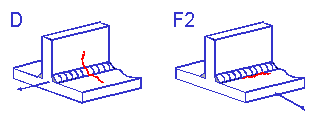
Two fillet welds are shown below. One is loaded parallel to the weld toe ( Class D ) and the other loaded perpendicular to the weld toe ( Class F2 ).
It is then assumed that any complex weld geometry can be described by one of the standard classifications.
Material Properties
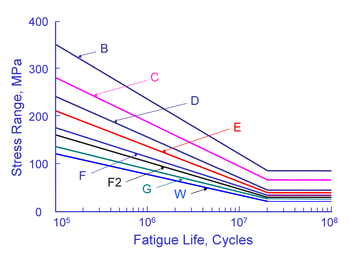
The curves shown above are valid for structural steel welds. Fatigue lives are not dependant on either the material or the applied mean stress. Welds are known to contain small cracks from the welding process. As a result, the majority of the fatigue life is spent in growing these small cracks. Fatigue lives are not dependant on material because all structural steels have about the same crack growth rate. The crack growth rate in aluminum is about ten times faster than steel and aluminum welds have much lower fatigue resistance. Welding produces residual stresses at or near the yield strength of the material. The as welded condition results in the worst possible residual or mean stress and an external mean stress will not increase the weld toe stresses because of plastic deformation. Fatigue lives are computed from a simple power function.

The constant C is the intercept at 1 cycle and is tabulated in the standard. This constant is much larger than the ultimate strength of the material.
The standard is only valid for fatigue lives in excess of 105 cycles and limits the stress to 80% of the yield strength. Experience has shown that the SN curves provide reasonable estimates for higher stress levels and shorter lives. In eFatigue, the maximum stress range permitted is limited by the ultimate strength of the material for all weld classes.
Design Criteria
Test data for welded members has considerable scatter as shown below for butt and fillet welds.
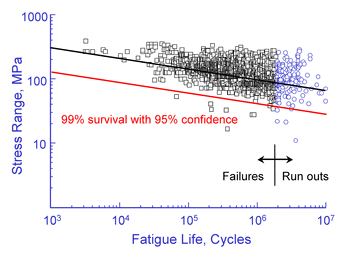
Some of this scatter is reduced with the classification system that accounts for differences between the various joint details. The standard give the standard deviation of the various weld classification SN curves.
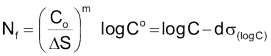
The design criteria d is used to determine the probability of failure and is the number of standard deviations away from the mean. For example d = 2 corresponds to a 2.3% probability of failure and d = 3 corresponds to a probability of failure of 0.14%.
© 2026 — Noble Pulse